Guidance for those who would create a fairer future.
I recently watched Adam Curtis’ documentary All Watched Over by Machines of Loving Grace. It was recommended to me as I had reached my capacity for reading (I know, I didn’t think that was a thing either). I believe it was originally broadcast as three separate programmes. While I did watch it in sections, it was more than he would have intended, simply because there was a lot to take in and consider. I made my notes as I went.
Curtis sees himself as a social commentator, an observer and documentarian rather than an activist(Curtis, 2011). That said, his topics, the people he includes and indeed excludes are a methodological choice and so, not neutral nor without politics. The film traces ideas starting back in the 1940’s with Ayn Rand and brings us into the present day (the documentary aired in 2011, so not quite present day). The film is long on genealogy but short on solutions, and I think that is by design. Curtis is showing us a story and encouraging us to draw our own conclusions. This article gives mine.
The myth of the level playing field
At the core of Ayn Rand’s philosophy, which she called Objectivism are autonomous individuals, rational actors who are free to pursue their interests without coercion. She said:
“My philosophy, in essence, is the concept of man as a heroic being, with his own happiness as the moral purpose of his life, with productive achievement as his noblest activity, and reason as his only absolute.” (Rand, 2007)
What Rand chooses to ignore is any pre-existing structural inequality. Perhaps she means for us to presume this issue is resolved either by her philosophy or prior to her philosophy being adopted. The former is an unreasonable assumption, nobody with existing wealth and power, pursuing his own interest is going to redistribute his fiscal or political influence. That is not rational, and would in fact be altruistic – the antithesis of Rand’s school of thought. The latter is more reasonable; however, Rand offers no roadmap to enable us to reach this level playing field.
The technocrats who took up objectivism as their motif, visualised the creation of an open-source universe, an online global community where knowledge is available to all and ideas can be shared. This would be the conduit for Rand’s philosophy. A noble goal, but what followed was (predictably?) not neutrality nor equality but amplification of existing power dynamics.
Open networks, open knowledge and open markets are not power free(Zuboff, 2020). Those with substantial resources, capital and status can utilise the information in ways that those without cannot. Essentially, the existing elites can mine the value from these open ‘quarries’ of information and extract more value, more efficiently.
Rand’s individualism seems to presume a moral symmetry which simply does not exist(Rand and Branden, 1964). Self-interest is not morally equal across individuals, and treating it as such is an error of judgement or intellect. The actions of self-interest for a hedge fund manager or CEO of a multi-national pharmaceutical company are not comparable to the actions of self interest of a single mother living below the poverty line or indeed a member of a marginalised religion in a war-torn country.
The abandonment of altruism is not neutral in any way. Choosing not to act or intervene in a system that is already skewed to protect the privilege of the few over the many is not amoral it is immoral. Inaction favours those already winning and so the gap widens rather than narrows.
If we were being unkind in our judgement of Rand and her philosophy, we could say it was the attempted justification of living a selfish life without having to feel the consequences of one’s actions. A life without accountability, any action justified as rational. However, if we then consider that while Rand espouses prioritisation of self and pursuit of one’s own happiness, when her chosen love, falls for someone else she goes into a tirade about betrayal and accuses him of being irrational.
As with any absolute dichotomy, it turns out that nuance is the undoing.
Rand’s system assumes that ‘true’ rationalism is coherent and stable, but desire, attachment and love have never been such. Much of the human race’s acts of self interest are routed in these things, meaning rationalism is perhaps out of the question for many decisions.
Nathanial Brendan’s reassessment of his own happiness, i.e. not being with Rand and being with another should be ‘allowed’ within Rand’s philosophy of objectivism, but the fact that she could not tolerate it shows that she was introducing conditions and demanding loyalty … moving from ideology to dogma.
The holy grail of market stability
Curtis holds a mirror up to the free market and highlights governments’ obsession with the unicorn of the free market – stability. In spite of all the evidence that shows the inevitability of the boom-and-bust cycle of capitalist economics, we refuse to give up on the belief that stability is achievable. Not because it is true, but because it is structurally necessary to those already in power. To abandon this cornerstone of western cultural belief would be to admit that the system itself is a problem, rather than arguing about the impact of the level of regulation by governments across the world.
The technocrats looked to model economies to predict and highlight risk, but computers do not act on the data, humans do(Curtis, 2011). And humans, well historically, their decisions are shown to be based on incentives, self-interest, institutional pressure and power. Automation does not remove selfishness; it informs and arms it.
Here we can shine a spotlight on Rand’s insistence that rational self-interest is not a flaw but a virtue and show just how dangerous this can be (has been). When individuals control systems and not just their own lives, acts of self-interest become catastrophically destructive. And those who suffer? Are not those who make poor choices (as we are lead to believe), but those without decision making powers or influence when systems break down, as they inevitably do. Those in the ivory towers go on making their choices, placing their bets and watching the world burn.
Open systems do not remain open, they are captured, monetised and governed by those with capital and influence. This is not a glitch in the matrix, it is a pattern. It is the base code.
‘The algorithm’ has bypassed global community and the creation of a universal collective. Instead, birthing echo chambers and grooming parlours that stoke the fires of division. Now the mass roll out of AI. Encouraging the average Joe to become so comfortable and reliant on it that critical thinking and autonomy are slowly eroded(Eubanks, 2018). Tech will not divert or disrupt domination, instead it allows, no, slowly instils within us an innate delegation of judgement, of memory, of responsibility. As autonomy erodes, so does resistance, not because people are coerced but because they are soothed. Critical thinking does not disappear overnight; it atrophies through disuse. Once people are trained to defer to metrics, to algorithms, to ‘what the system says’, they stop seeing themselves as moral agents at all.
Limits to growth
What Jay Forrester (and later Limits to Growth) called for was that governments move from encouraging a state of growth, to maintaining an equilibrium(Donella H. Meadows, 1972). His modelling assumed that once evidence showed endless growth was impossible, political systems would pivot toward balance. That assumes governments can ask populations with little to accept permanent restraint, and ask populations with much to voluntarily give up their advantage. Perhaps a moral authority such as religion could override national interest, but history shows us how ineffective religions have been at creating unity.
The proposal/recommendation required deferred gratification, collective sacrifice, trust in intangible promise of a better future. A secular theology with no authority, no shared cosmology, and no enforcement mechanism. Meanwhile, the actual global religion, capital accumulation, had well establishedrituals, rewards, sanctions, and institutions.
Money was not just influential. It was already deified.
This, all set in the 1970s when there was nothing to stabilise. Wealth was unevenly distributed, industrialisation was unbalanced, colonial extraction was recent or incomplete and irresponsibly managed. To declare a steady state under these conditions effectively encapsulates and holds injustice in place. Call for restraint is illogical? Immoral? Implausible? Impossible?
While communism held strong in a few states what existed in the 1970s was not communism as shared responsibility and equality, but state capitalism with authoritarian control. Power, privilege, and hierarchy persisted (often more brutally) just under different symbolism.
So, Forrester’s imagined alternative had no existing example or community who could speak of a lived experience, capable of demonstrating that restraint without domination was possible.
I am not arguing that Forrester’s modelling was inaccurate or the results wrong, but that the thing with digital systems predicting human systems is, that they do not allow for enshrined privilege or that those who benefit most from continuous growth are those with the decision-making powers. He was working against a system where greed is not individual vice, it is structurally rewarded and rewarding. Expecting self-regulation and altruism in these environments is unrealistic.
And so, Curtis brings us to the uncomfortable realisation that equilibrium requires either an enforced equality, or a moral order strong enough to compel sacrifice. Capitalism provides neither.
Limits to Growth, developed by the MIT team led by Donella Meadows, building on Jay Forrester’s foundations, predicted that the early decades of the next century would see, well, just what we are seeing. The report warned that if corrective action was delayed, collapse would not look like a single catastrophe, but like, compounding crises, policy incoherence, short term fixes that deepen long term damage. Feels uncanny, right?
To be clear though, this is not fate. It is consequence. The model was not a prophecy, conditions for course correction were laid out but roundly rejected due to systemic governance by self-interest(Donella H. Meadows, 1972). Those in power hedged their bets using our future as the ante, they won and so, as modelled, we lost. The dynamics were allowed to run.
At this point it is easy to become fatalistic and say that we are likely to become through our own stubbornness and greed the architects of our own demise. No utopian future
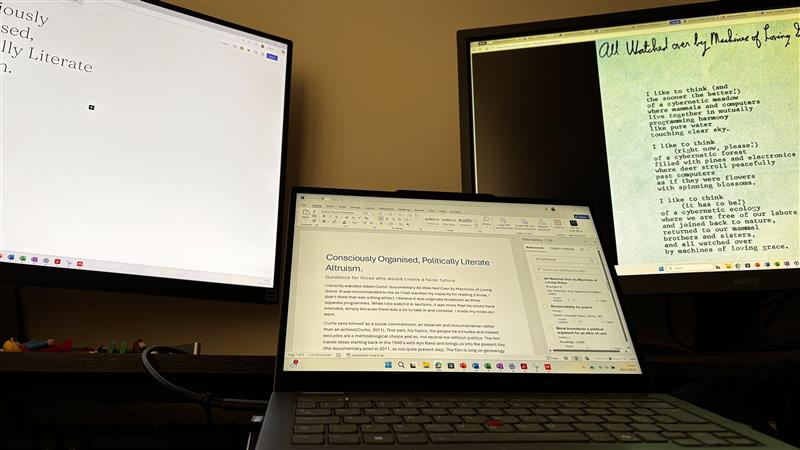
‘Where we are free of our labors
and joined back to nature,
returned to our mammal
brothers and sisters,
and all watched over
by machines of loving grace.’
(Brautigan, 1967)
In fact, more likely that our tendency toward idleness leads us to a place where sentient AI destroys the parasitic human race to save the earth from destruction.
This would make great reading for those who enjoy a bit of science fatalism fiction, but the truth is much less dramatic. The danger is not sentient AI, but the ramping up of delegated responsibility to systems such as AI, controlled not by Machines of Loving Grace, but by humans of greed, privilege and an ingrained belief in their own superiority.
If we allow ourselves to withdraw, which is a rational response to a sense of powerlessness – that is how we lose. Blaming humanity as a whole, as a species, is convenient to those in power. It strips those responsible of accountability.
There is no benevolent machine future waiting to save us from ourselves. We must save ourselves. Through resistance, through demanding accountability, by accepting responsibility and building solidarity. We mustn’t surrender these things to machines and call it progress.
For me, building solidarity is where we need to do the most work. Solidarity today is not a stable social condition but an exception, often marginalised, informal, and framed as naïve, subversive, even deviant. Solidarity hasn’t organically eroded, it has been systematically dismantled by competitive or combative moral narratives i.e. the deserving and the underserving, the scroungers, the immigrants, the creation and distillation of them and us. What remain are fragments. Pockets of solidarity exist where they resist the dominant order of things. When care, mutual aid, or collective responsibility are treated as deviant, that tells you something about the system’s values(Tronto, 2009). In essence solidarity has become counter-cultural.
But solidarity cannot be summoned like some daemon, it needs to be learned, practised, normalised and protected. Some would say solidarity is on the rise, through political groups like Reform however, what this represents is not actual solidarity. It is a classic strategy to maintain the status quo. Fragment horizontally, so that nothing is challenged or moved vertically.
The People are not naturally hostile to refugees(Gramsci, 1992). The hostility has to be narrated, repeated, emotionally charged, constantly and consistently renewed. The reason is simple. If the people as a collective,ever connected their precarious and unfair positions in life to the stark imbalance of capital concentration, the system or at least the legitimacy of the system would collapse. To prevent this, attention is redirected towards targets which are easily identifiable, powerless, ‘other’. It is misdirection, smoke and mirrors on the biggest stage in the world.
Also, division is much cheaper than repression. It is far more efficient to persuade people that their neighbour is the enemy than to suppress them outright. When anger is displaced downward or sideways, elites remain untouched and can (and do) present themselves as the protectors.
This is why billionaire tax avoidance is abstracted, normalised, legalised, but a refugee in a dinghy becomes a moral emergency. Mass solidarity is being prevented, but local, relational solidarity keeps re-emerging despite everything stacked against it. Our persistence is key.
Large-scale movements rarely begin as majorities. They begin as inconvenient minorities, misfits, people accused of being unrealistic, radical, or naïve. Hi, that’s me – is it you?
Gramsci told us that ruling elites maintain control and dominance not just through obvious means such as force or economic control, but through making things seem like common sense(Gramsci, 1992). The work of change is slow at first because it has to make what is commonly accepted as obvious and right, feel strange and wrong.
But I cannot write an essay or a blog post, that nobody will read and hope to out-message a system with more money, media control, and institutional reach. That is not how change happens.
So why write it?
I am relying on history repeating itself. I am waiting for the elite to overplay their hand. As conditions worsen, the scapegoat narrative will get louder, more frantic, more implausible. Eventually, lived experience will contradict the story. That moment is not visible from where we are sitting now. But (I hope, no, I believe) it is not hypothetical.
Until that point what do we do to stop ourselves from feeling like we are screaming into the abyss? What can we do, without feeling constantly exhausted, pessimistic, beaten down, angry, overwhelmed and burnt out?
We must remember this, you do not need optimism about the future to act with integrity in the present.
Hope is not a mood. It is a practice. Continue to act as though people matter even when the system insists, they do not. You do not need to feel hopeful to act in ways that affirm human worth. You can be tired, angry, or pessimistic about systems and still practise hope. Keep doing the work of care, judgement, and solidarity not because you believe history is bending the right way, but because not doing it would mean surrendering your own moral agency.
This is the kind of hope that survives where others burn out. It does not promise a better future. It insists and creates a better present, even if it is only on a small scale, that is still progress, that is still resistance.
Why is it my responsibility?
It is not the responsibility of those working 60 hours a week for minimum wage (Young, 2013). Any political change that implicitly requires a surplus of time, emotional safety, or unpaid organising of labour from people who are already exhausted is morally incoherent. Expecting the most oppressed to carry the burden of systemic change is not radical, it is continuation of exploitation disguised as empowerment.
People who are kept permanently tired, anxious, and distracted are not failing to resist. They are being managed. Those with time, security, education, institutional access, authority – those with voices that can be heard? They carry disproportionate responsibility for change, precisely because they are less constrained.
The problem is that modern power has learned how to deny responsibility while retaining control, frame structural advantage as individual merit, and reframe systemic harm as personal failure. This is one of the system’s greatest and most evolutionary protective achievements.
Now, alongside the traditional routes of influence and control we have added on the intentional control of down time. The algorithm in your hand while scrolling on the bus, in bed, on the toilet further advances segregation and undermines the building of positive solidarity …… the odds are stacked in favour of continuity not change.
In my view responsibility for change must not sit with the exhausted many, and so it falls to three other groups. Firstly, those within institutions with leverage, educators, professionals, managers, civil servants, regulators, designers, academics. These people who sit inside systems can on some small scale slow them down, reinterpret rules, protect dignity, refuse, resist, disrupt.
Secondly, those with narrative power. Journalists, teachers, writers, filmmakers, curriculum designers, anyone shaping how causes and consequences are explained. When blame is redirected downward, someone had to tell that story first – don’t tell it! Don’t show a narrow, divisive perspective – tell the full story. How uncomfortable is the last chapter of Curtis’ documentary which highlights that the seed planted by liberals leaving the Congo encouraged an uprising which led to genocide? This was not an inevitable result of historic tribal rivalry as it was portrayed. Tell the truth, the uncomfortable, invisible truths.
Finally, the responsibility falls to those of us with slack. People with time, security, mobility (even if just in small amounts). We have a duty. Do not mistake your comfort with innocence, recognise your privilege and use it, be the catalyst not the bystander.
It is unglamourous, invisible, relentless work, but it is important.
To conclude my foray into philosophy, I would say that I am a realist who practices hope and I encourage you to join me. I accept that the odds favour continuity, collapse is easier than transformation and exploitation is more efficient that justice. But I do not surrender.
We must not respond to this reality by blaming human nature or demanding heroism from the exhausted, or mistaking our awareness for action. The only sustainable, indeed rational and realistic position is this. Those with capacity must act. Without demanding hope, gratitude, or participation from those without it.
This is not an ideology; I am not offering total explanations nor do I claim moral innocence nor universal responsibility. Neither is this a movement; I have no desire to create an in-group which inevitably drifts towards purity tests and dogma. I do not have the answers, I am just writing down what I see, and I recognise that what I see is influenced by who I am and where I sit in this world.
Is this a philosophy? Possibly. More of a practice, an ethical orientation grounded in political realism and accountability. I don’t know. People far cleverer than me, who won’t read this would define it better than I. I am just a girl trying to make sense of the world. All the while ‘watched over by machines of loving grace……….’ Perhaps?
Bibliography
Brautigan, R. (1967) All Watched Over by Machines of Loving Grace. San Francisco: Four Seasons Foundation.
Curtis, A. (2011) “All Watched Over by Machines of Loving Grace.” United Kingdom: BBC.
Donella H. Meadows, D.L.M.J.R.W.W.B.I. (1972) The Limits to Growth. Club of Rome.
Eubanks, Virginia. (2018) Automating Inequality: How High-Tech Tools Profile, Police, and Punish the Poor. St. Martin’s Press .
Gramsci, A. (1992) Prison Notebooks. Edited by Joseph A Buttigieg. New York: Columbia University Press.
Rand, Ayn. (2007) Atlas shrugged. Penguin Books.
Rand, Ayn. and Branden, Nathaniel. (1964) The virtue of selfishness : a new concept of egoism. Signet.
Tronto, J.C.. (2009) Moral boundaries a political argument for an ethic of care. Routledge.
Young, I.Marion. (2013) Responsibility for justice. Oxford University Press.
Zuboff, Shoshana. (2020) The age of surveillance capitalism : the fight for a human future at the new frontier of power. PublicAffairs.


 Calcined Bauxite Fragments
Leave a comment