Today I was going to sleep. I remain exhausted and while study and writing bring me a sense of purpose and with it a sense of peace, I recognise that I do also require sleep. Restful sleep that allows my brain to settle.
The plan was to eat some toast and have a cup of tea in bed and then sleep. However, I decided to watch something while I had my breakfast, and I stumbled across this lecture by Richard Sennett, Craft and the Digital Age, given at the MAK – Museum of Applied Arts, in Vienna in 2016. I watched it all, committing much more time than the ten minutes it took me to devour my highly nutritious breakfast of Nutella on toast (don’t judge me). And now, as a consequence (of the lecture not the Nutella) I am sat up in bed typing away, not resetting my brain but getting down on ‘paper’ everything I took from this slow (not a criticism) and compelling talk.
I had been stumbling in my reading and writing to define craftsmanship in a way that I could then apply to groundworks and highways maintenance and here Sennett does so effortlessly.
“… in English we make a distinction between craft and craftsmanship. A craft is usually thought of as a manual activity. Craftsmanship is thought of as the quality of work, and more than that, doing good work for its own sake. Craftsmanship implies a degree of objectification not merely of production. Whereas a craft could be merely a productive activity, craftsmanship is a quality embedded in the making. The great drama of craftsmanship is how that quality gradually gets built up in a productive act.”
(Richard Sennett, 2016)
Sennett goes on to explain three elements which he considers to be imperative to developing this quality. He defines them as the rhythm of skill, the relation between problem solving and problem finding and finally, time. Sennett is drawing parallels between the craftsmanship of playing a musical instrument and computer programming. On the surface, extremely different mediums, but ultimately what Sennett shows is that if something is a craft, then these three things can be universally applied when defining how we move from simple production, to high quality making.
Listening to Sennett speak also helped me to sit more comfortably with something I have been struggling with for months. I have been wrestling with how to reconcile the conditions needed to develop the skills of apprentices with the landscape of the capitalist economy and the culture of performativity in education. Sennett says quite plainly, that there is no reconciling these things.
To enable craftsmanship to develop we must allow the continuous process of learning and unlearning, moving from “tacit, explicit, tacit again – not one right way, but many ways”. Basically, we have to accept that “Craft work is slow… The only way to learn properly is to slow things down. Slow time allows consciousness to surface.” All things which grate against the culture of “time is money”. This links directly with the ideas from Marchand’s ethnographic studies of apprenticeships in Yemen and Mali which describe time and repetition as essential. Skill develops through long exposure to materials, tools, mistakes, and bodily recalibration. This process is uneven and cannot be rushed without altering what is learned. (Marchand, 2008)
Sennett gives the example of Windows 10 and the move of tech companies to release products “prematurely”, taking the responsibility of feedback for required improvements from the craftsman before the product is finished to the consumer/layman after it has been sold. This burden of explaining what is going wrong without the language or expertise to be able to do so effectively is backward. I see this set up playing out in the construction industry too.
I, of course, challenge the language and attitudes of apprentices as needed at the training centre. But they are learning the language and attitudes from their time on site. “it’s not going on my house”, “nobody will ever see it”, “Get it done quickly, not perfectly”, “that will do”.
The results of which are not felt by the groundworker, but by the customer, the person who comes to buy the property as their home or use the premises to house their business, as well as the customer care manager and the gangs on “snagging”. The fact that a whole team is employed to carry out the work of snagging speaks to the demise of craftsmanship and “quality of work … doing good work for its own sake” does it not? An example is given below.
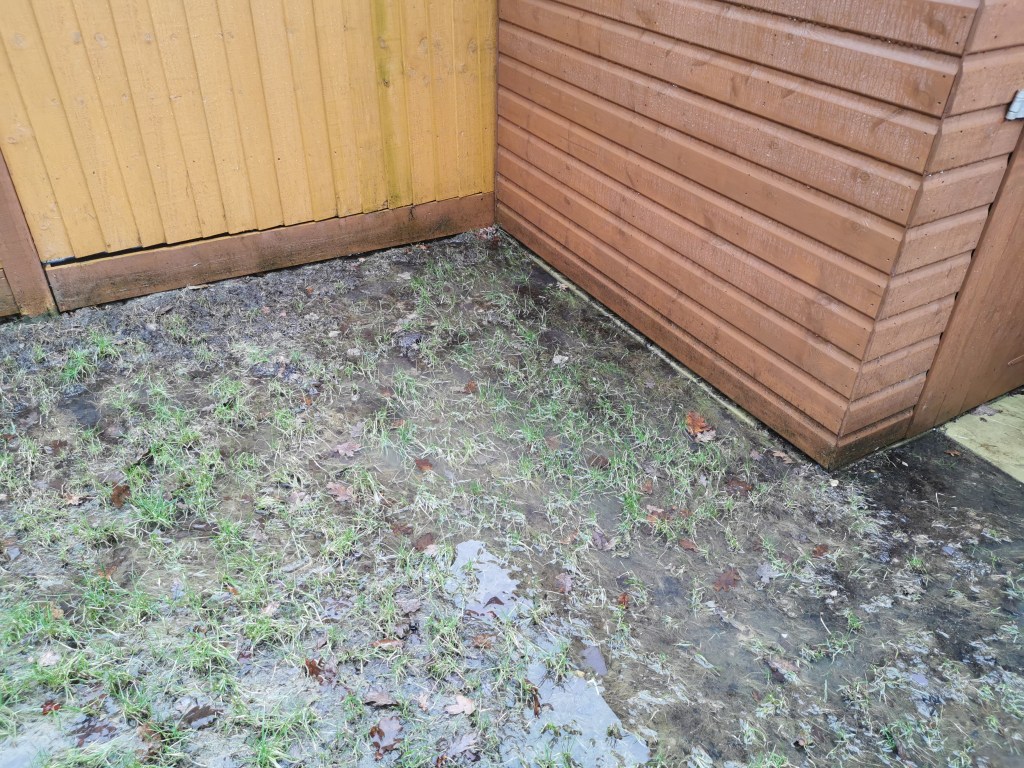
An acquaintance of mine had asked for some help as they were not getting anywhere with the developer from whom they had recently purchased a new build house. Their garden was repeatedly flooding and had become unusable as a result. They had gone back and forth with the customer service manager. My acquaintance is a warehouse manager and so has no expertise in drainage and the customer service manager was employed (obviously) for their people skills and so was not a drainage expert either. The conversations back and forth between these two lay persons, with correspondence and conversations no doubt had behind the scenes with experts, could have been entirely avoided had:
- quality work been carried out at the design, survey and planning stage.
- quality assurance checks been regularly and robustly observed during the build.
- feedback had not been left to lay people post sale.
The original suggestion for remedy made by the developer (via the customer service manager) was to install a land drain in the garden and connect it to the existing drainage system. My acquaintance assumed this to be a reasonable suggestion. However, when I reviewed the photos and the recommendation, I could see what had been put forward was the easiest option, but one which would not resolve the issue. The developer was offering to install a system which would mean that the garden would still flood and then the surplus water slowly drain away. I did not deem this to be a satisfactory resolution as the garden would continue to flood. The solution needed to be a drainage system which diverts the water away before it reached the property so that it doesn’t flood in the first place. Put simply, a drain on the other side of the fence. More difficult, as this would involve other property owners and possibly create other issues leading to the need for further remedial action (problem solving and problem finding).
I could immediately see as Sennett spoke, slowly, calmly, softly and yet at the same time passionately, that his ideas could not only reach across the realm of music to programming but also to groundworks. This gives me the courage of my convictions to say that Groundworks is a craft and that those who have been given the time and space to develop their skills, are craftsmen. Something which I knew I can now justify.
Sennett ends his lecture by talking about the emergence of an urgency within society to have the latest, the newest thing. The generally accepted idea that this means the best version of, well everything, phone, computer, car, trainers etc etc ad infinitum. Perhaps (and I say perhaps purposefully, as this is not an academic claim nor one based on lived experience as I do not play video games – not as some protest or claim to better pass times – you do you – purely because they give me vertigo) FIFA may be the optimum example of this? £70 forked out every year for the new game – but is it really new? I don’t know. Perhaps I am just a cynical dinosaur, but it seems like money for old rope. Or perhaps I am wrong, perhaps it is an example of actual craftsmanship? Each iteration improved upon based on learning, development, new understanding ….. however, a quick google would lead me to say, probably not:

(Games Learning Society Team, 2024)
A product released knowing there are issues which range from slightly irritating to “drastically impactful” where consumers are tasked with reporting back to enable ‘patches’ to be added.
It sounds somewhat like the system for reporting and temporarily fixing potholes as they occur. If – as one of my apprentices has proposed as part of her midpoint mock assessment – wherever possible, we took the time to put in permanent fixes, repairs made with care and skill as opposed to the pack it, whack it and run to the next job approach …. What then? Fewer revisits to the same site to repair the temporary fix with another temporary fix. Lower overall costs. Better quality roads. Pride in a job done well…
“you may say that I’m a dreamer” …
Well, I have gone from the possibility of a post breakfast nap to a post lunch snooze. Here’s to curiosity, to craft, to slow time, to tacit knowledge and to sleep.
May we have all of these things in our lives this year.


 Calcined Bauxite Fragments
Leave a comment